Written by: Anna Bryan Professional Editor
Reviewed by: Pacific Press Publishing Team
Last Updated: November 2026
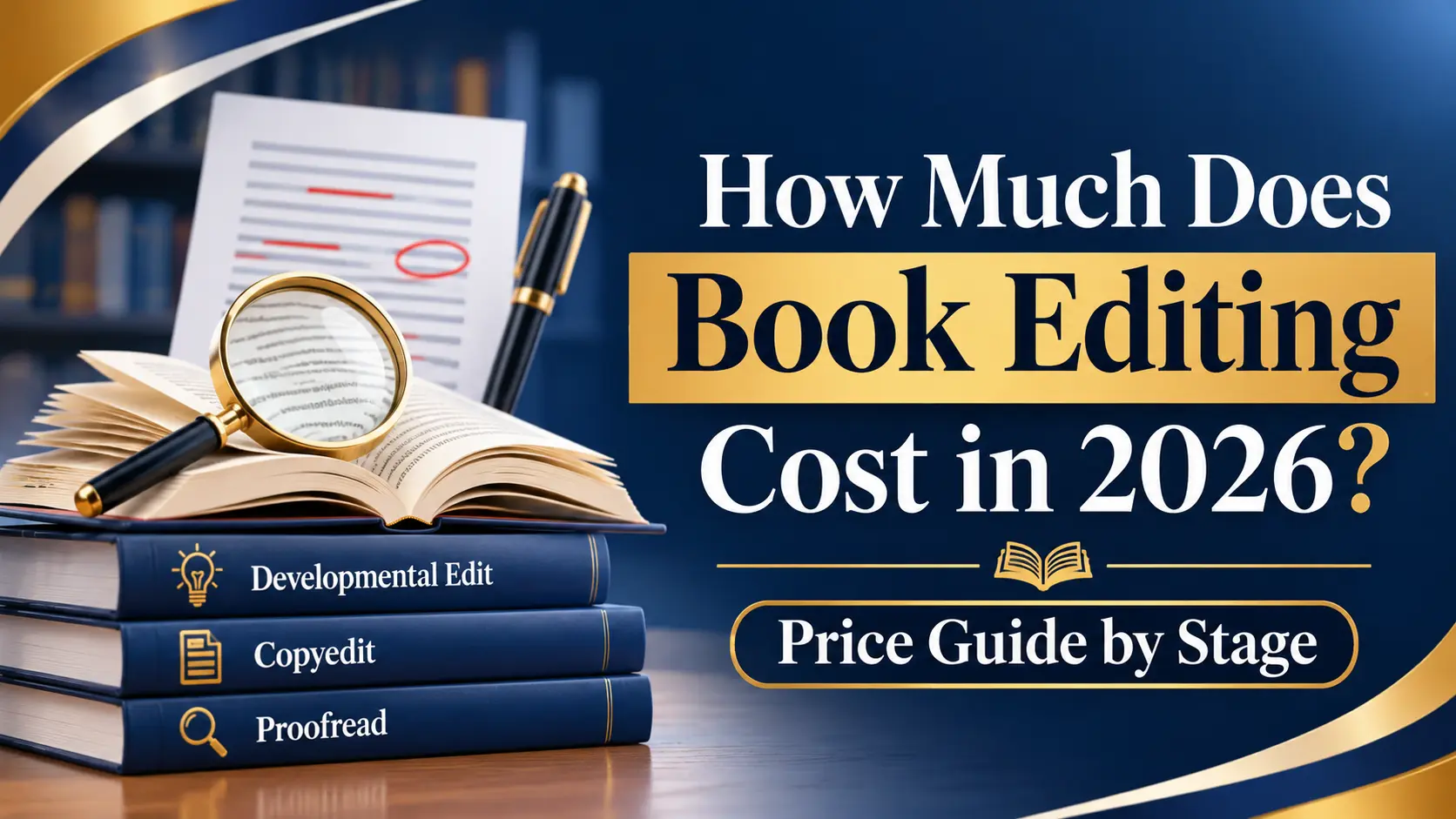
Fiction editors mostly charge between 1.2 and 3.5 cents a word, and where you land in that range depends on the stage. On an 80,000-word novel, the book editing cost works out to roughly $960 to $2,800 per stage. Buy developmental editing, copyediting, and proofreading together and you’re at about $5,000 to $6,600. The figures come from the Editorial Freelancers Association (EFA) 2026 rate chart, and I’d use them to sanity-check quotes, not treat them as a price list.
If you’ve already asked around, you know the quotes don’t line up. One editor says $1,200. Another says $6,000. Both sound sure of themselves, and both can be right, because they’re often quoting different jobs.
Full disclosure: we offer editing at Pacific Press Publishing, so I’ve stuck to public rate data here instead of leaning on our own pricing. Here’s what’s coming: the cost of each stage, the reasons quotes vary so much, and a simple way to stack them against each other so the fine print doesn’t trip you up.
How Much Does Book Editing Cost?
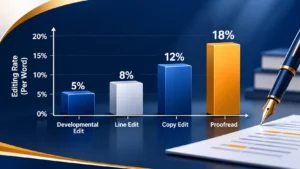
Book editing prices come down to two things: the stage and your word count. The EFA’s 2026 fiction medians start around 1.2 to 2.0 cents a word for proofreading and climb to 3.0 to 3.5 cents for developmental editing. Run those through an 80,000-word novel and you get this.
| Editing stage | Fiction rate per word | Cost for 80,000 words |
| Developmental edit | 3 to 3.5 cents | $2,400 to $2,800 |
| Line edit | 2.7 to 3.5 cents | $2,160 to $2,800 |
| Copyedit | 2 to 2.7 cents | $1,600 to $2,160 |
| Proofread | 1.2 to 2 cents | $960 to $1,600 |
These numbers come from the EFA 2026 Rate Chart, via Editor World’s summary. More than 1,100 editors reported what they charged in 2025, and nonfiction tends to cost more than these fiction rates.
Reedsy’s marketplace data from 2025 is surprisingly close. Its averages: roughly 2 cents for proofreading, 2.7 for copyediting, and 3.6 for developmental work.
Book Editing Cost per 1,000 Words and per Page
Per 1,000 words is easy math: multiply the cents by ten and you’ve got dollars. Two cents a word is $20. For pages, the EFA counts 250 words, so that same 2 cents comes to $5 a page. I ran the conversion on the fiction medians.
Proofreading comes to $12 to $20 per 1,000 words ($3 to $5 a page). Copyediting is $20 to $27 ($5 to $6.75 a page), and line editing is $27 to $35 ($6.75 to $8.75). Developmental editing sits at $30 to $35 per 1,000 words, or $7.50 to $8.75 a page.
So, how much does an editor charge per page? Depends what they call a page. A $5 rate means 2 cents a word at 250 words per page, but only about 1.7 cents at 300, so the same sticker price can be a better or worse deal than it looks.
What Does Each Stage Cost and Cover?
Every stage tackles a different problem, and the price tracks how much work that takes. If the terms still run together in your head, our post on developmental editing, copyediting, and proofreading sorts them out.
Developmental Editing Cost
A developmental editor reads for the big stuff: plot, structure, and pacing in fiction, or argument and chapter order in nonfiction. That’s why the developmental editing cost sits at the top of the range. They’re holding your entire book in their head, and you usually get an editorial letter at the end. After that comes the rewrite, which costs you time even if it costs nothing extra.
Copyediting Cost and Line Editing
A copyeditor cleans up grammar, spelling, and consistency, so the “Dr. Lee” in chapter two doesn’t turn into “Doctor Li” by chapter nine. Line editing digs into voice and sentence rhythm. The copyediting cost runs lower since nobody’s reshaping your story, but editors use these terms loosely, so ask what’s actually included before you compare prices.
Proofreading Cost
Proofreading is the last pass, done on the formatted pages. The proofreading cost is the lowest per word, yet it’s the stage people regret skipping, because formatting creates fresh glitches of its own. If your layout isn’t done yet, our book formatting page shows what that step involves.
Why Do Book Editing Prices Vary So Much?
Usually because a “copyedit” from one editor isn’t the same job as a “copyedit” from another. Five things move the number most:
- Word count. Double the length, double the bill. A 120,000-word manuscript costs twice what a 60,000-word one does at the same per-word rate.
- Genre. Nonfiction usually costs more. One 2026 summary of the EFA chart puts nonfiction copyediting at roughly 3 to 4 cents per word.
- Manuscript condition. A clean draft takes less time than one full of leftover comments and formatting problems.
- Turnaround. Rush jobs cost extra.
- Who does the work. Editor World’s pricing guide lists developmental editing at $0.07 to $0.15 per word, well above the EFA median.
Is a higher quote automatically a rip-off? No, not by itself. What matters is whether you can see where the extra money goes, maybe a second reader, a long editorial letter, or a delivery date they’ll actually commit to. If the editor can’t point to anything, that’s when the price starts to look off, and it’s a quick way to check whether book editor rates are fair.
What Does the Cost to Edit a Novel Look Like in Practice?
Scenario one. Say you’ve finished an 80,000-word fantasy novel and you’ve got $3,500. Your beta readers got through it and followed the story, so you skip developmental editing. Copyediting plus proofreading at EFA medians runs $2,560 to $3,760, which fits unless you land at the top of the range.
Scenario two. Picture a consultant with a 50,000-word business book. Copyediting at roughly 3 to 4 cents a word comes to $1,500 to $2,000, and that’s before proofreading. If the argument still wobbles, adding developmental editing changes that total fast.
Whichever route you take, ask for the quote itemized by stage. That’s how we do it at Pacific Press Publishing, with a clear quote before any work starts, and it turns checking against the benchmarks above into a five-minute job.
How Can You Lower Your Editing Bill Without Cutting Quality?
Spend where the manuscript is weakest, and do the cheap work yourself first. For manuscript editing for self-publishing, these moves save the most:
- Revise twice before anyone else reads the draft.
- Let beta readers catch the structural problems, since they cost little or nothing.
- Clear out comments, “fix later” notes, and odd formatting so your editor’s hours go to real problems.
- Pick a longer turnaround when your schedule allows.
- Skip a stage only on purpose. Drop developmental editing if beta readers understood the book, but never the final proofread.
A grammar app can sweep out obvious typos beforehand, though it won’t notice that chapter six drags. And if you’re mapping out the rest of your budget, our step-by-step self-publishing guide covers the other costs.
How Do You Compare Editor Quotes Fairly?
Put every quote in the same unit, then check what’s actually included. Cost per word editing is the common unit, so start there.
- Find the per-word rate. Divide each total by your word count.
- Confirm the stage. Ask whether a “copyedit” includes line-level changes.
- Ask for a sample edit. Around 1,000 words is plenty. Don’t just look at what got fixed. Notice whether the editor explains their changes, because that tells you how they’ll treat the rest of your book.
- Get dates in writing. Do this before any deposit changes hands, and ask how many revision rounds or follow-up questions the price covers.
- Question the extremes. A price far below the benchmarks, or a quote that won’t say what’s included, deserves a second look.
What Should You Do Next?
Your real book editing cost comes down to word count times the stages you need. Here’s a twenty-minute job for today:
- Pull an exact word count from your latest draft.
- Take the per-word ranges from the table and multiply, one line for each stage you want.
- Email three editors, send each the same sample pages, and ask for a quote plus a sample edit.
Then line the quotes up using the steps above and book whichever stage your manuscript needs first. If you’d like one more quote in the pile, Pacific Press Publishing’s book editing team can look at your manuscript, or you can get in touch to start the conversation.