
Your book is live, and the review count still says zero. Here’s how to get book reviews when you’re an unknown author: put your book in front of a small group of real readers before launch, ask them plainly for an honest opinion, and make the whole thing take two minutes. Nobody wanders in and reviews a stranger’s book on their own, so you have to find those first readers yourself.
I know that sounds like a lot of effort for a few lines of text. But a handful of reviews in release week changes how your page feels to a cold shopper. Let’s get them without bending a single rule.

Why Book Reviews for New Authors Are So Hard to Get
Most readers never write a review. They finish the book, feel something, and reach for the next one. That’s true even for books they loved.
New authors get hit twice. Shoppers skip a book with no reviews, and without sales, nobody’s left to write any. Frustrating, right?
The loop won’t break by itself. You break it by hand: find a few readers, give them the book early, and ask politely. Every tactic below is a version of that one move.
What Honest Book Reviews Look Like (and What Gets You in Trouble)
Honest book reviews come from real readers who chose to read your book and said what they thought. You can ask for them. You can’t buy them, trade for them, or nudge anyone toward five stars.
Retailers take this seriously, and Amazon book reviews are policed closely. Paid reviews are banned, and reviews from people close to the author are restricted, so check Amazon’s current customer review guidelines for authors before launch. Free advance copies are normal in publishing, but the opinion has to stay the reader’s own.
Disclosure matters too. A reader who received a free copy should say so, and US readers should follow FTC guidance on endorsements and reviews.
Here’s a quick gut check:
- Fine: a free copy with no strings, a request for honest feedback, and one or two polite reminders.
- Not fine: paying for reviews, swapping reviews with other authors, asking your cousins for five stars, or offering a gift card for a post.
Where to Find Readers When You Have No List
No audience doesn’t mean no options. It just means you go to the readers instead of waiting for them to arrive.
- Genre reader groups that allow author posts.
- Readers who comment on books similar to yours.
- Your first few newsletter signups, even if you only have five.
- Fellow authors in your genre who are happy to share your call for readers (sharing is fine, swapping reviews is not).
Quality beats quantity here. Ten people who adore your genre are worth more than fifty who said yes just to be polite. So when you reach out, lead with their taste, not your book.
How to Get Book Reviews Before Launch Day
The best reviews are planted weeks before your release date. Launch week is chaos, so do the groundwork while things are quiet.
Build a Book Launch Team From Nothing
A book launch team is about 20 to 50 readers who agree to read an advance copy and post a review once the book is live. No email list? That’s okay. Start in the places listed above and keep your first ask small.
Skip family. Invite people who’d pick up your genre anyway, since their opinions carry real weight with other shoppers.
Say Maya writes cozy mysteries and has zero subscribers. She spends two weeks leaving genuinely useful comments in two reader groups, then posts a short call for advance readers where the rules allow it. Twelve people raise their hands, and for a debut, twelve is a solid start. Want the full schedule? See our step-by-step guide to self-publishing a book.
Run an Advance Reader Copy Campaign
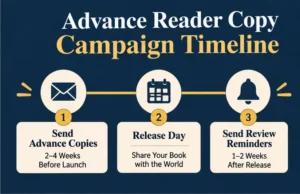
Advance reader copy reviews are only as good as the copy you send. Hand over a fully edited, proofread file, because readers will happily mention typos in public. Then use a delivery tool or an ARC platform so each person gets a format that works on their device.
Timing trips up a lot of authors. Reviews usually can’t go live on retail sites before your book does, so give everyone a release date and one direct link. And tell them, in so many words, that a three-star opinion is welcome.
Write a Book Review Request That Gets a Yes
A good book review request is short, personal, and specific. Four parts do the job:
- Who you are, and why you picked this reader.
- What you’re offering, such as a free advance copy.
- What you’re asking: an honest review on release day, with any rating.
- The date and one link.
Here’s the flavor: “I loved your post on grief memoirs, and mine is one. Want an advance copy? Honest feedback is all I’m after.” Notice there’s no sales voice and no pressure. It reads like one person writing to another.
How to Get First Book Reviews After Launch
Some of your launch team won’t follow through, and that’s normal. Don’t take it personally. Keep a few steady habits going, and expect a trickle rather than a flood.
Put the Ask Inside Your Book
Readers are most generous right after a satisfying last page. Add a short note at the end with a direct link to your review page. Two or three warm sentences and a thank-you are plenty.
Pitch Niche Reviewers One by One
Bloggers, newsletter writers, and podcast hosts in your genre often love new titles. Mass emails get deleted, though. One real detail from their own work makes yours stand out.
Take Dan, who self-published a budgeting guide. Rather than blasting 200 addresses, he writes 15 individual emails over two weeks, each naming an article the recipient wrote. It’s slower, but it proves he actually read their work.
How to Get Book Reviews From Readers Who Simply Forget
Most people who skip a review aren’t being rude. They meant to, and then life happened. A single reminder on release day, plus one gentle nudge a week later, covers it.
Keep the tone light. Something like “Hi Sam, the book’s live today. Here’s the link whenever you’re ready, and thanks so much for reading” does the job. After that, stop, and thank everyone who read the book, whether they posted or not. Goodwill brings them back for your next release.
A Simple Review Pipeline You Can Actually Track
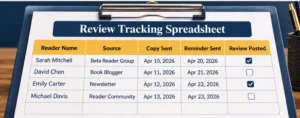
Most advice stops at “ask nicely.” A tracker gives you something more useful, because it shows where your reviews really come from. A basic spreadsheet is enough.
Make one row per reader, with columns for name, source, copy sent, reminder sent, and review posted. Then follow four stages:
- Invite: send the request and note where you found the person.
- Deliver: send the copy with the release date and link.
- Remind: one note on release day, one a week later.
- Thank: reply to everyone, posted or not.
After a month, scan the source column. If one community produced most of your reviewers, spend more time there. Also invite more people than you need, since some readers won’t finish in time.
Mistakes That Quietly Cost You Reviews
Even when you know how to get book reviews, small slips can stall everything. The good news is that they’re easy to fix.
- Asking too late. Readers need time to finish, so invite them weeks ahead.
- Making people hunt. If they have to search for your book, many won’t bother. Send one direct link.
- Chasing five stars. Pressure on the rating breaks the rules and costs you trust.
- Going quiet. Readers who hear nothing from you drift away.
What to Do With a Lukewarm Review
An honest three-star review still helps you. It shows shoppers your page isn’t padded with praise, and it often points at something worth fixing in your next book. A mix of ratings also tends to look more believable than a wall of perfect scores.
So don’t argue, and don’t ask anyone to change their review. If the reader was on your team, send a private thank-you and get back to writing.
Your Next Step: Send Ten Invitations Today
Learning how to get book reviews comes down to one habit: asking real readers, one at a time, and making it easy to say yes. You don’t need an audience to start. You need a short list and a clear message.
Give it 20 minutes today:
- List ten readers who enjoy your genre, skipping relatives.
- Write your request using the four parts above.
- Send the first one before you close this tab.
If you’d like help planning the rest of your launch, see our Book Marketing Services.